
Cognitive hierarchies: Mental categories and their structure
Why do the same categories, in the same hierarchical sequence, emerge repeatedly across cognition? I investigate the hypothesis that there is a homology between hierarchical structure found in language, concepts, and the brain.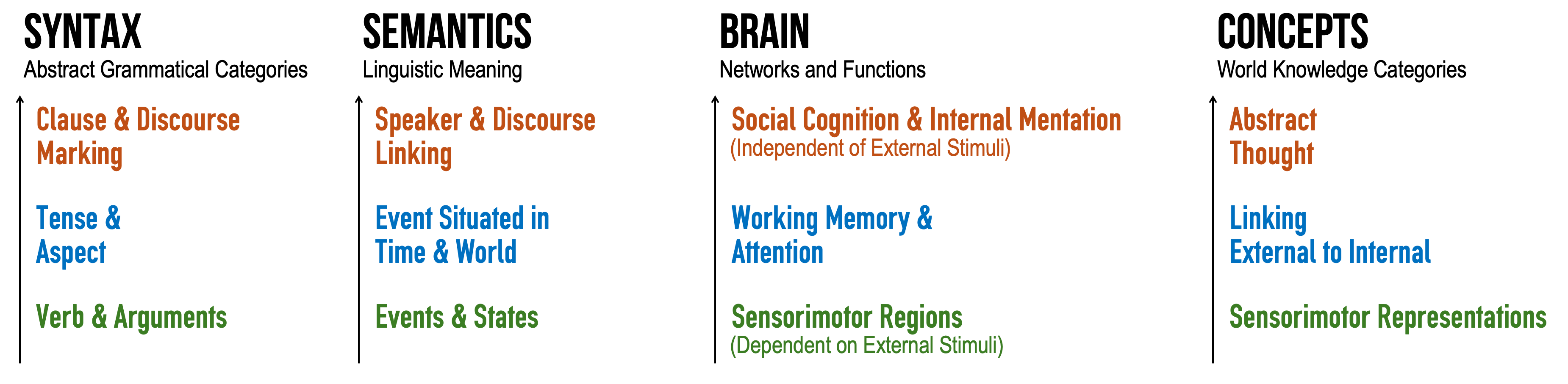

SYNTAX: a hierarchy of grammatical categories (the syntactic functional hierarchy) in which the verb and its arguments are nested in tense and aspect phrases, which are themselves nested in clause- and discourse-marking phrases (Chomsky, 1995)
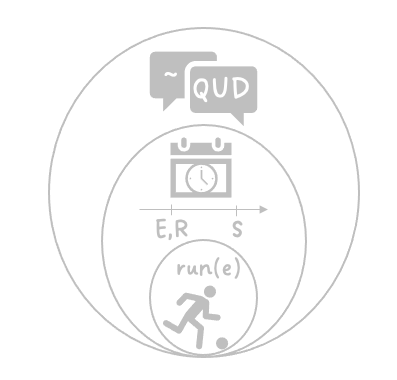
SEMANTICS a hierarchy of categories of linguistic meaning from event (kind), to event situated in a time and world (token), to situations related to speakers and anchored to a discourse (Ramchand & Svenonius, 2014)
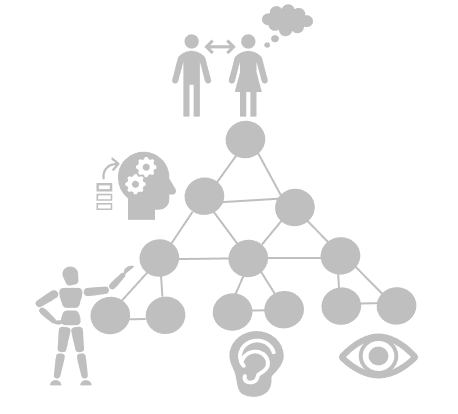
BRAIN: a hierarchy of embedded, interconnected networks of functional connectivity that extend from segregated regions dependent on external stimuli toward integrated regions independent of external stimuli (the Sensorimotor to Association axis), and these regions' associated functions (the neural functional hierarchy): sensation and perception, working memory and attention, and social cognition, narrative, and internal mentation (Margulies et al., 2023)
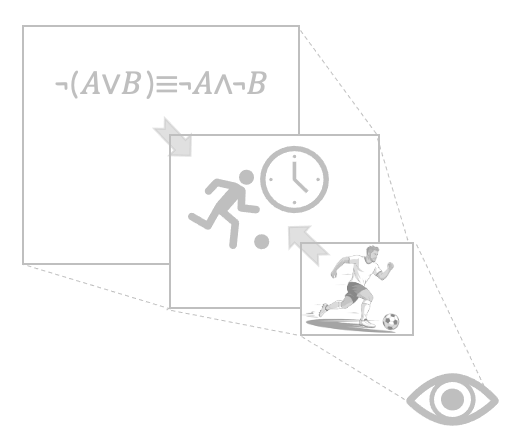
CONCEPTS: a hierarchy of conceptual models of the world increasing in complexity and representations of categories increasingly abstracted away from sensorimotor representations, to those linking representations of the external to representations of the internal, to entirely internal thoughts independent of sensorimotor representations (Wing et al., in prep)
Concepts: Shared properties with language
If conceptual and syntactic categories are related in a principled way, minimally they should share properties. Do conceptual categories exhibit properties widely acknowledged for syntax, such as hierarchical structure and qualitative differences in domains of categories? To investigate this, I run offline and real-time processing experiments using linguistic and visual stimuli, such as sentence-picture matching and self-paced reading.
Wing, E. and Atlmann, GTM. 2026. | html
Wing, E., Koval, P., and Tabor, W. 2025. | hsp poster
Prystauka, Y., Wing, E., & Altmann, GTM. 2024. | html
Wing, E. and Koval, P. 2023. | amlap poster
Compositionality: The nature of the mechanism that combines categories
The productivity and systematicity of language and though suggest the meaning of an expression is compositional, or a context-insensitive function of its parts. But consider the conceptual hue of red elicited by the same adjective combined with different nouns: red car (typical red), red hair (orange), red squirrel (brown). The difference seems to arise from the adjective’s sensitivity to conceptual knowledge associated with each noun, challenging context-insensitive models of meaning combination. I am comparing predictions for when and how during language comprehension context sensitivity effects such as these should arise by testing cases like close and open + the umbrella, which combine via the same compositional rule yet activate distinct event representations. I am testing real-time word-by-word meaning combination for this case using eye tracking in the Visual World.
Wing, E. and Tabor, W. 2026. | elm poster
Acquisition: The syntactic hierarchy and acquisition sequences
An ongoing collaboration with Michael Diercks (Pomona College) and Kaya LeGrand (UConn) tests structure-building accounts of child language acquisition, which argue that children acquire categories from bottom to top of the syntactic hierarchy. Motivated by the established finding that progressive (they are eating) is hierarchically lower than perfect (they have eaten), we tested whether progressive is acquired before perfect in longitudinal English production data and find strong support for this sequence.
Wing, E., LeGrand, K., and Diercks, M. 2026. | bucld abstract
Brain: The syntactic hierarchy and neural functional connectivity
(coming soon!)